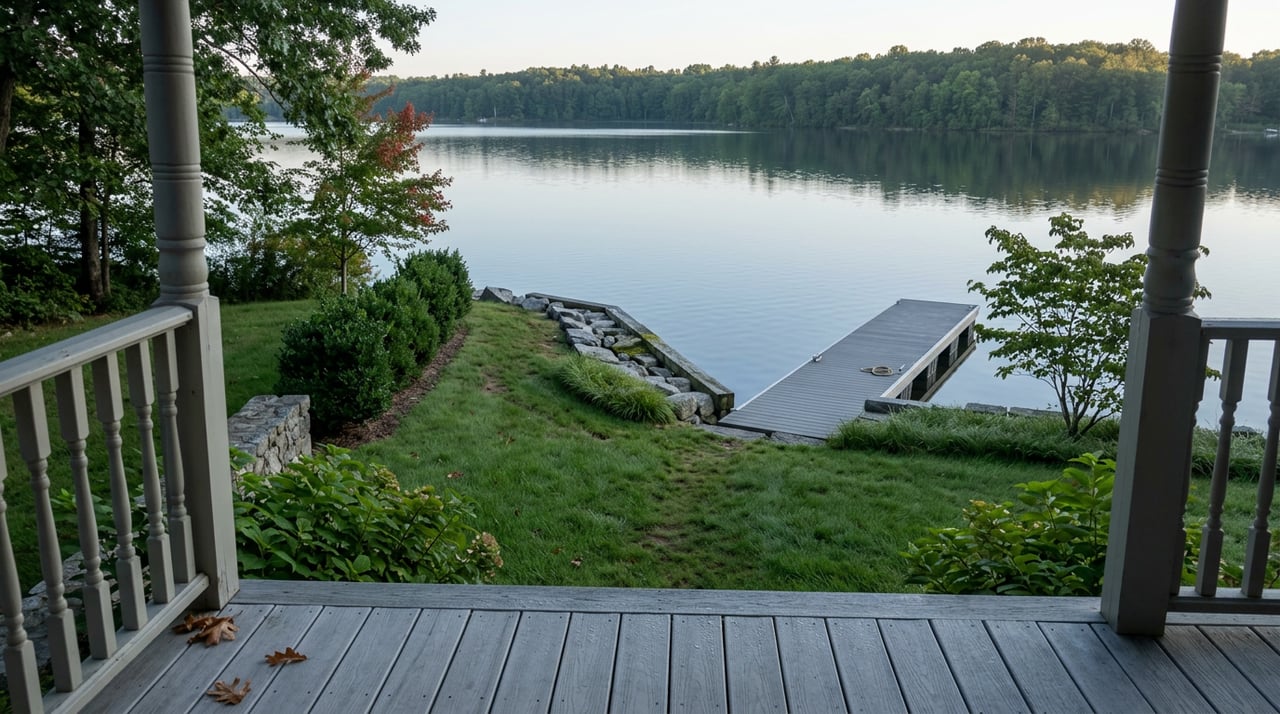
By July 2026, staff at Bridgewater Marina were climbing a stepladder to reach gas pumps that had sat at eye level a year earlier. A few coves over, Virginia Dare Cruises captain Barry Bridges was watching the shoreline for a telltale plume of reddish water, his signal that a shallow spot had appeared where none had been before. Smith Mountain Lake was down close to five feet from its normal level, its worst dry stretch since 2007, and for the first time in years, the difference between a "waterfront" listing and a "deep water cove" listing stopped being a phrase agents typed into MLS descriptions and became something you could measure with a tape.
For buyers comparing properties in Union Hall, where deep water cove shows up in listing after listing as a selling point, this matters more than it might elsewhere on the lake. The drought did not just lower the water. It ran an unplanned experiment on every dock at the lake, and the results split cleanly along lines that have nothing to do with square footage or list price.
The Five Feet Nobody Priced In
Smith Mountain Lake's normal operating range sits between 793 and 795 feet in elevation, with 795 treated as full pond. Through the spring and summer of 2026, the lake slid to around 789 to 790 feet, and a technical drawdown analysis published by SML+ put the low point at roughly 788.6 feet on July 7, 2026. That is within about a foot of the lake's all-time recorded low of 787.6 feet, set back in January 1970. In more than fifty years of records, this was one of the closest calls the reservoir has had.
The cause traces to a 75 percent collapse in natural inflow. Water flowing into the lake system fell from roughly 1,311 cubic feet per second in February 2026 to about 330 cubic feet per second by July 2026, according to the SML+ analysis. Appalachian Power, which operates the Smith Mountain Project under a federal license, responded by activating drought trigger points that cut downstream releases in stages, first on April 27, 2026, and again on May 11, 2026. By late June 2026, releases from Leesville Dam had dropped below the 650 cubic feet per second threshold normally reserved for weekend recreation flows.
The part worth sitting with is what didn't happen. A third, deeper conservation stage exists in the water management plan, but under its own rules it can only be declared after September 30, or during a narrow winter window between December and March. That means the plan's strongest water saving tool was legally off the table during the exact months when evaporation and recreational demand were highest. The lake kept dropping through peak season with the company's hands, by design, partly tied.
Why This Isn't Really a Weather Story
Here is the fact that changes how a buyer should read a listing. Appalachian Power's federal license requires it to protect downstream flows and generation capability. It does not require the company to maintain a minimum lake elevation for recreation. The goal of keeping the lake near full pond exists because it helps generation, not because any rule obligates the utility to keep docks wet.
That single fact does more to explain Union Hall's real estate language than any brochure copy does. If the entity controlling lake elevation has no contractual duty to protect your dock, then the only real insurance a buyer has is the physical geometry of the specific cove the house sits on. Depth, slope, and how a cove connects to the main channel become the actual variable, not the word waterfront stamped across a listing.
This is why "deep water cove" recurs so often in Union Hall property descriptions. Communities like Kennedy Shores, Highland Lake, Admirals Landing, and The Water's Edge each cut into different fingers of the lake, and those fingers do not share a floor. Some stayed fully navigable all summer. Others left boats stranded on their own lifts.
What Actually Happened on the Water
The drought's effects were not evenly spread. A few patterns showed up consistently in coverage of the lake through the summer:
- Bridgewater Marina, sitting in naturally deep water with one of the lake's larger rental boat fleets, stayed fully accessible even as the lake dropped, according to the general manager at Mango's Bar and Grill inside Bridgewater Plaza.
- Boat ramps in shallower coves became unusable or required extending well past their normal footprint before reaching water.
- Cruise operators like Virginia Dare had to plot new routes around shoals that had never surfaced before, adjusting paths in real time based on visible signs of shallow water.
- Bedford Water, which serves part of the lake's customer base, asked residents to voluntarily cut back usage as the drought stretched on.
- By early September 2026, businesses tied to lake traffic, including Smith Mountain Lake Coffeehouse, reported foot traffic down roughly 20 percent from prior summers, even with Labor Day weekend crowds still arriving.
None of that reads as unusual weather commentary. It reads as a stress test that separated properties whose deep water claims were structural from properties whose deep water claims were seasonal.
The Question That Actually Separates One Listing From Another
A comparable sale from two years ago will not tell a buyer which of these categories a Union Hall property falls into, because two years ago the lake was near full pond and every dock looked the same. The honest question to ask before making an offer on a cove lot is not whether the listing says deep water. It is what the dock depth measured at the lowest point this summer, and whether the seller or their agent can produce that number rather than a photo taken when the lake was full.
A dock that stayed functional at 789 feet tells you something concrete about the years ahead. A dock that sat dry tells you something too, and it is not necessarily disqualifying, since plenty of buyers care more about privacy or price than year round depth. What matters is knowing which one you are buying before you own it, not after the next dry summer arrives.
Drought is not a novel event at Smith Mountain Lake. The SML+ analysis notes the reservoir has historically cycled through drought roughly every five to seven years, with drops of five to seven feet each time. This year's version simply arrived at the same time as an unusually thin inflow year, which is what pushed the lake close enough to its 1970 record to make headlines. The next dry cycle will come. The cove that held its depth this time is likely to hold it again.
What This Means If You're Comparing Properties Right Now
If you are looking at Union Hall listings this fall, ask for more than the marketing language. Ask what the dock looked like in July. Ask whether the cove connects to a deeper channel or sits at the end of a shallow finger. Ask whether the seller has any record, even informal, of how the water behaved during past low periods. None of this shows up in a median price figure, and none of it shows up in a standard comparable sale analysis. It shows up only when someone asks the right question at the right time, and this year gave every Union Hall property a very public answer.
A Few Questions Worth Asking
Will the lake stay this low through the fall? The third and deepest conservation trigger in the management plan cannot legally activate before September 30 in most circumstances, so conditions could still shift as that date passes. Buyers touring properties in late September or October should ask for the most current reading rather than relying on summer photos.
Does a shallow dock this year mean the property is a bad buy? Not necessarily. Plenty of buyers value privacy, price, or shoreline character over guaranteed year round depth. The point is knowing which trade you are making, not avoiding shallow coves altogether.
Is this specific to Union Hall? The drought affected the whole lake, but Union Hall's mix of long, narrow coves off the Franklin County side means the variation between "deep" and "shallow" waterfront shows up more starkly here than in areas with wider, more uniform shoreline.
If you're weighing a specific Union Hall waterfront or water access property and want a straight answer on how its cove actually performed this year, not just how it photographs, Debbie Shelton can help you ask the right questions before you write an offer. And if you're the one holding a deep water lot that just proved its worth this summer, a current home valuation is a good place to start figuring out what that proof is worth on paper.