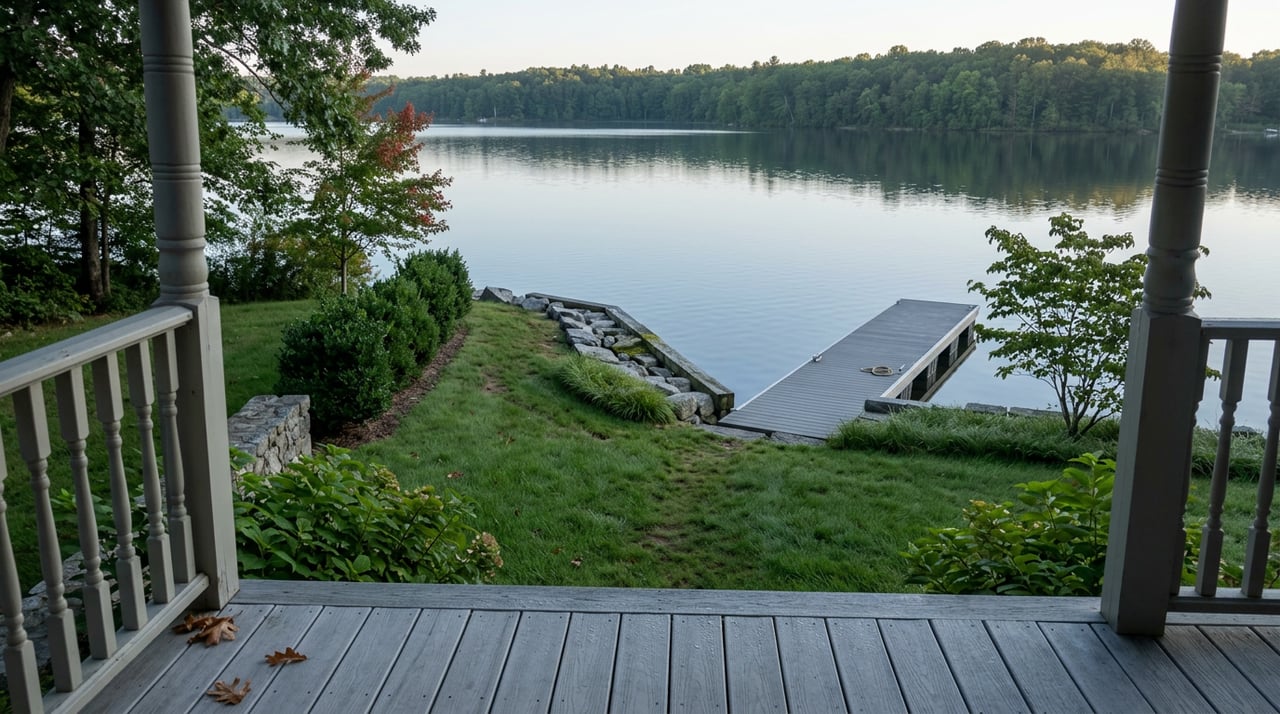
Two docks sit less than a quarter mile apart on the Cool Branch arm near Penhook. Same cove, same lake, same general vintage of home. One owner spent a Saturday morning locating a septic tank lid because a county notification letter arrived on its five year anniversary. The other owner has never received anything like it and never will, because her house happens to sit a few hundred feet to the east, across a boundary that exists only on a survey plat.
That boundary is the Franklin and Pittsylvania county line, and Penhook straddles it in a way that matters more to a home sale than most people realize. The lake doesn't care where the county line falls. The septic rulebook does.
The Line Under the Water Matters More Than the View
Penhook sits entirely inside Franklin County, and Franklin County has required septic pump-outs or inspections near Smith Mountain Lake since 2006. The rule is specific: any onsite sewage system located within 500 feet of the lake's 795-foot contour has to be pumped or inspected once every five years, and the property owner has to register that system with the county for a $35 fee. Franklin County's GIS parcel viewer has a layer built for exactly this question, labeled the SML 500Ft Septic Buffer, so anyone can check a specific lot against the line before assuming they're covered or exempt.
There's a wrinkle inside the wrinkle. A pump-out isn't always required if an inspection shows the tank is still in good shape. Superior Septic Services, a Rocky Mount company that works this exact rule daily, describes it as a solids-level test: if the solid buildup is under 30 percent, the county will accept an inspection instead of a full pump-out, though they recommend pumping once solids pass 20 percent just to stay ahead of the next five-year deadline. That's the kind of detail that only shows up if you've filled out the compliance form more than once.
Cross Into Pittsylvania and the Rule Disappears
Here's where Penhook's geography changes the math. The community's eastern edge runs along the Pittsylvania County line, following the Cool Branch arm of the lake. A shoreline lot on the Franklin side of that line answers to the mandatory pump-out ordinance described above. A shoreline lot a short distance away on the Pittsylvania side does not, because Pittsylvania County has no equivalent mandatory program. It simply follows the Virginia Department of Health's general guidance, which recommends inspection every three to five years but doesn't require it and doesn't send anyone a reminder letter.
Bedford County, which borders other parts of the lake, took a third approach entirely. It adopted its own mandatory pump-out requirement only recently, phasing it in with notices going out in 2025 and compliance deadlines tied to when a given property received its letter. None of that touches Penhook directly, but it's worth knowing that all three counties around this one lake have landed on three different answers to the same question. Nobody wrote a regional rule. Each county wrote its own.
| County | Mandatory pump-out near SML | Frequency | Who enforces it |
|---|---|---|---|
| Franklin | Yes, within 500 ft of the 795-ft contour | Every 5 years | County registration, $35 fee |
| Pittsylvania | No, VDH guidance only | Recommended every 3-5 years | No mandatory registration |
| Bedford | Yes, phased in starting 2025 | Every 5 years | County notification letters |
For a Penhook property, the practical question isn't "how close am I to the water." It's "which county's line is my septic tank actually on."
Virginia Just Added a Rule That Doesn't Care Where You Live
None of this addresses the part of the picture that changed for everyone in the state, not just lake residents. Governor Youngkin signed HB 2671 on March 20, 2025, and it took effect July 1, 2025, setting a new statewide expectation for septic inspection and disclosure at residential property conveyance. It applies to any home sale in Virginia involving an onsite sewage system, whether that home sits 50 feet from Smith Mountain Lake or five miles from it.
This is the layer that catches inland Penhook sellers off guard. A house well outside the 500-foot buffer never had to think about county pump-out registration. Under the new state standard, it still needs a documented septic inspection and disclosure at the point of sale, covering the system's location, maintenance history, and whether it has passed or failed prior inspections. That inspection has to come from a licensed Onsite Sewage System Professional, not a general home inspector checking a box.
The stakes are real. A lot of the housing stock around this part of the lake dates to the 1960s through the 1980s, old enough that a septic system reaching the end of its working life isn't unusual, and a full repair or replacement can run well into five figures depending on soil conditions and system size. Sellers who get ahead of that with a documented inspection before listing are in a much stronger position than sellers who wait for a buyer's inspector to find the problem first.
What This Means If You're Listing in Penhook This Fall
A few steps make this manageable instead of stressful:
- Pull up the property on Franklin County's GIS parcel viewer and check it against the SML 500Ft Septic Buffer layer. Don't assume based on how close the water looks from the porch.
- If the parcel falls inside that buffer, confirm the system's registration and pump-out or inspection history with the county. If it's never been registered, that's a same-week fix, not a same-year one.
- Schedule an inspection with a licensed OSSP before you list, regardless of where the buffer line falls. This satisfies the new statewide disclosure standard and gives you a documented answer instead of a guess.
- If the property sits near the Pittsylvania line, confirm which county actually has jurisdiction before assuming either the mandatory program or its absence applies.
- Keep every receipt with a date on it. Buyers, their agents, and increasingly their lenders will ask for it.
None of this is about generating anxiety over a home that's perfectly fine. It's about knowing which rulebook applies before a buyer's inspector or a closing attorney raises the question first.
Two Questions Worth Settling Before You List
If my septic already passed the county's five-year inspection, does that satisfy the new state disclosure law too? Not automatically. The county requirement and the state requirement are separate regimes that happen to sometimes overlap. A single OSSP inspection scheduled with both in mind can often cover both boxes, but it has to be documented as such. Worth confirming with your inspector before the appointment, not after.
My home isn't near the water at all. Does any of this apply to me? The Franklin County mandatory pump-out program does not, since it only reaches 500 feet from the lake. The statewide disclosure standard from HB 2671 does, since it applies to any Virginia residential sale involving a septic system, regardless of distance from Smith Mountain Lake.
Septic rules aren't the most interesting part of buying or selling a home at the lake, but they're exactly the kind of detail that surfaces at the worst possible moment if nobody checks it early. Whether your parcel sits inside Franklin's buffer, across the line in Pittsylvania, or well back from the shoreline entirely, the smart move is knowing the answer before a contract does.
If you're weighing a sale in Penhook this season, or trying to understand what a specific parcel's septic obligations actually are before you make an offer, Debbie Shelton can walk through the county-specific details with you and connect you with inspectors who know this stretch of the lake well. Start with a Get a Free Home Valuation and bring the questions with it.