If your search around Penhook includes farms in both Franklin and Pittsylvania counties, those farms are heading into winter with very different rainfall behind them. In Franklin County, October 2026 was the 26th-wettest October in 132 years, 2.29 inches above normal, and by the Drought Monitor reading of November 10, 37.1% of county residents were in drought. In Pittsylvania County, October came in only 0.28 inches above normal, January through October was the 5th-driest stretch on record at 10.07 inches below normal, and 100% of residents were in drought on that same reading.
For a horse-property buyer, that gap shows up in the first winter's feed bill. What a farm will cost to run this year depends on how much hay its land made in 2026 and whether that hay is stored under a roof. The listing doesn't tell you either one, so you have to ask.
Hay Bought From Away Costs Roughly Double
Virginia Tech extension veterinarian Dr. John Currin laid out the numbers for WSLS in September. Most producers lost 30 to 70% of their first hay cutting this year. Hay a Virginia farmer would normally grow for about $150 a ton was running $200 to $300 a ton bought out of state, once trucking was included. Currin told the station that diesel had reached as high as $6.79 a gallon on one delivery run.
That same WSLS report described a farm that had put up about half its usual hay and was bringing in more from Tennessee. Closer to Penhook, WSLS reported in June that a Pittsylvania County rancher found local hay drought-struck as well and expected he might have to bring feed in from out of state. In late August, a Bedford County grower told WFXR that his yield had dropped from about 90 square bales an acre to 35 to 45. He was hauling hay from more than 150 miles away, and local hay was selling for twice the previous year's price.
Current auction prices tell the same story. At the Rushville, Virginia hay auction on November 18, 2026, USDA's market report showed good-to-premium third-cutting mixed-grass large squares averaging $109.50 a bale and medium rounds at $82. For 2025, the VDACS Harrisonburg price series put good mixed-grass medium and large rounds at an average of $49.64 a bale. The two figures come from different markets with different bale categories, so they don't line up exactly. Both point the same way: a round bale costs far more this winter than last.
By October 13, every county and independent city in Virginia carried a 2026 USDA drought designation, according to VDACS, and Pittsylvania had been designated directly back on May 7. The shortage reaches well beyond a few unlucky farms.
The County Line Runs Under the Pasture, Too
We've written about how the Franklin-Pittsylvania line decides which septic rules apply to a lake home. This year it also says something about how much rain a farm's grass got.
| Drought.gov county page, data valid Nov. 10, 2026 | Franklin County | Pittsylvania County |
|---|---|---|
| Share of residents in drought | 37.1% | 100% |
| October 2026 vs. normal | +2.29 in., 26th-wettest | +0.28 in., 51st-wettest |
| Jan.–Oct. 2026 vs. normal | −4.44 in., 28th-driest | −10.07 in., 5th-driest |
These are countywide numbers measured by residents and rainfall, not field-by-field pasture surveys. A bottomland field in Pittsylvania may still look better than a thin hilltop in Franklin. As a starting point, though, a Franklin County farm had a wet October to help its fall grass, while a Pittsylvania County farm is still roughly ten inches behind for the year. Currin made the same point to WSLS: fall grass growth before frost would decide how much winter hay owners could save.
For a buyer, the practical takeaway is that two farms with the same acreage and the same asking price can come with different costs for the first winter. One may have grass to graze and a loft of its own hay. The other may need to buy everything at $200-plus a ton.
What to Ask on a Winter Showing
Most horse-property buyers walk the fences and look at the stalls. This winter, add a few questions that put a number on what the place will cost to run.
- How much hay did the farm put up in 2026, and how many cuttings? Compare that to a normal year if the seller knows. Hay that's already in the barn at closing is worth something, since replacing it costs more this year.
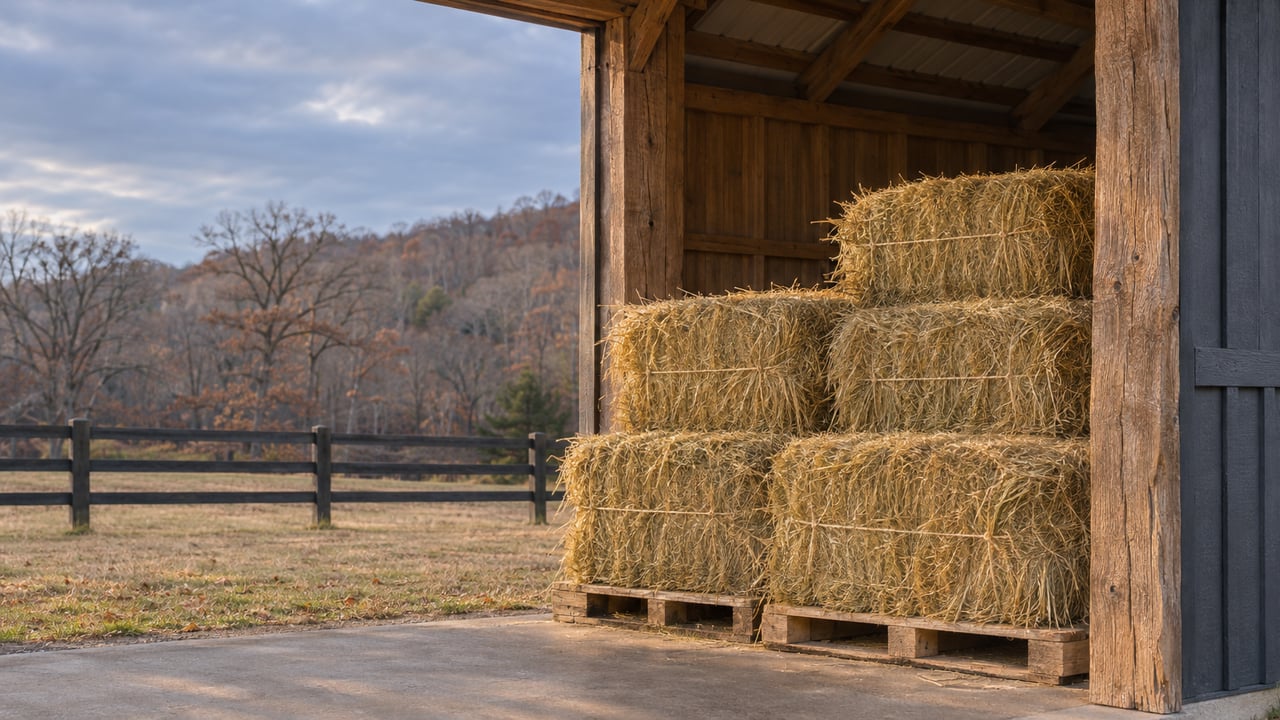
- Where is the hay stored? A covered hay barn holds its value through a wet winter. Hay stacked outside loses quality, and this year it costs more to replace.
- What height is the pasture going into winter? Virginia Cooperative Extension horse-pasture guidance written during this spring's drought says not to graze or mow drought-stressed cool-season grass below six inches. Once a pasture is down to about four inches, it says to move horses to a dry lot and feed hay.
- Is there a dry lot or sacrifice area? That same guidance relies on one to protect the pasture while it recovers. A farm without one either means building one or overgrazing the field you paid for.
- How many acres per horse does the land support? The Extension guidance gives a general figure of two to three acres per horse, and more on difficult ground. Compare that with your herd before you compare prices.
None of these answers shows up in a listing's acreage. They also tend to separate a farm that carries itself through a dry year from one that depends on a hay truck.
Who Supplies a Horse Farm Around Penhook
When a farm runs short, these are the suppliers it relies on. Tractor Supply's Rocky Mount store at 58 Virginia Market Place Drive has a feed center for equine and livestock feed. Bedford Cooperative has a Gretna branch at 306 North Main Street and two Chatham locations, at 968 Halifax Road and 485 Tightsqueeze Industrial Road. Its stores are running a hay-ring and feed-bunk sale from November 1 through December 31, 2026, while supplies last.
For hay itself, the VDACS Hay Clearing House is the state's public listing service. Its November 5 issue includes listing updates through November 13. The closest seller in its Danville/Martinsville section is Iron Gate Ranch in Bassett, which lists first-cutting mixed-grass round bales with price on request. Virginia Farm Bureau also runs hay resources that connect buyers and sellers.
For veterinary care, Pell Animal Clinic's farm services page describes ambulatory large-animal and equine care in Franklin County, with a 24-hour emergency line at (540) 483-7444. The county Extension offices are where to ask about pasture and forage. In Franklin County, Grace Neller is the Agriculture and Natural Resources agent. In Pittsylvania County, Rebecca Roberts covers animal science and Stephen Barts covers crop and soil sciences.
If you want to ride beyond your own fence, Fairy Stone State Park's 10-mile Little Mountain trail system is open to horses. Its equestrian camp has 10 sites and 10 stalls, and the 2026 campground season runs through December 7. Our earlier guide to acreage, farms and rural retreats around Penhook covers the wider land market south of the lake.
A Few Questions Buyers Ask
Does a dry year lower what a horse farm is worth? The research behind this post doesn't measure that. It does show that running a farm got more expensive in 2026, and that a farm able to grow and store its own hay is protected from that cost in a way a farm without those things is not.
Is a Pittsylvania County farm a poor buy this winter? No. The county figures describe rainfall across a whole county, not a particular field. A Pittsylvania farm with good bottomland, a full hay barn and a dry lot can come through this winter better than a Franklin farm without them.
When will pasture recover? That depends on rain this winter and spring. As of the November 10 Drought Monitor reading, Pittsylvania County was still entirely in drought, and Franklin County had improved after a wet October.
If you're weighing horse property near Penhook this winter, or getting ready to sell a farm with a full hay barn and pasture that held up, I'd be glad to walk the land with you and put those details in front of the right buyer. Debbie Shelton, Berkshire Hathaway HomeServices Smith Mountain Lake Real Estate. Get a Free Home Valuation.